The Opportunity Cost of Social Bubbles
Nearly two years ago, me, my friends and our children went up the mountain next to Sofia. It was a late summer day in September - possibly the last hot one. We were way too fast getting up where we wanted to, so we decided to take an alternate route going down - one that would lead us down a famous waterfall. The waterfall was truly splendid and we enjoyed it brilliantly until we saw the path down. Little did we know how difficult and scary that path would be. At times I had to crawl and at all times we had to watch our step while still trying to keep pace, so we can make it out before sunset. Still, we made it down the mountain, just before sundown and had the most delicious dinner I have ever had in my life. I will forever remember that day even though this is the only picture I made. Not so, had we chosen the usual, easy path.
So lately I have been thinking about how hard it can be to choose to go on an unfamiliar path of any kind. And sometimes the barrier might not be a lack of curiosity, but rather the discomfort of stepping out of the cosy social bubble we’ve built around what we know and what feels good to us.
What am I talking about? The effects of the social bubbles we are seeing more and more as a problem. Social media has been a huge driver of this - it is much easier to go through content, under the guidance of a platform that knows what I resonate with, than putting in the effort to try and expose myself to a diverse set of topics. And we humans are lazy by design - we want to conserve our energy, so we can use it for other things. Like taking unfamiliar routes in mountains.
Well, that is so until we realise what the easy path costs us - and then we might actually choose the hard one. So, what is the opportunity cost of staying in our own comfort bubble?
The Agile Bubble
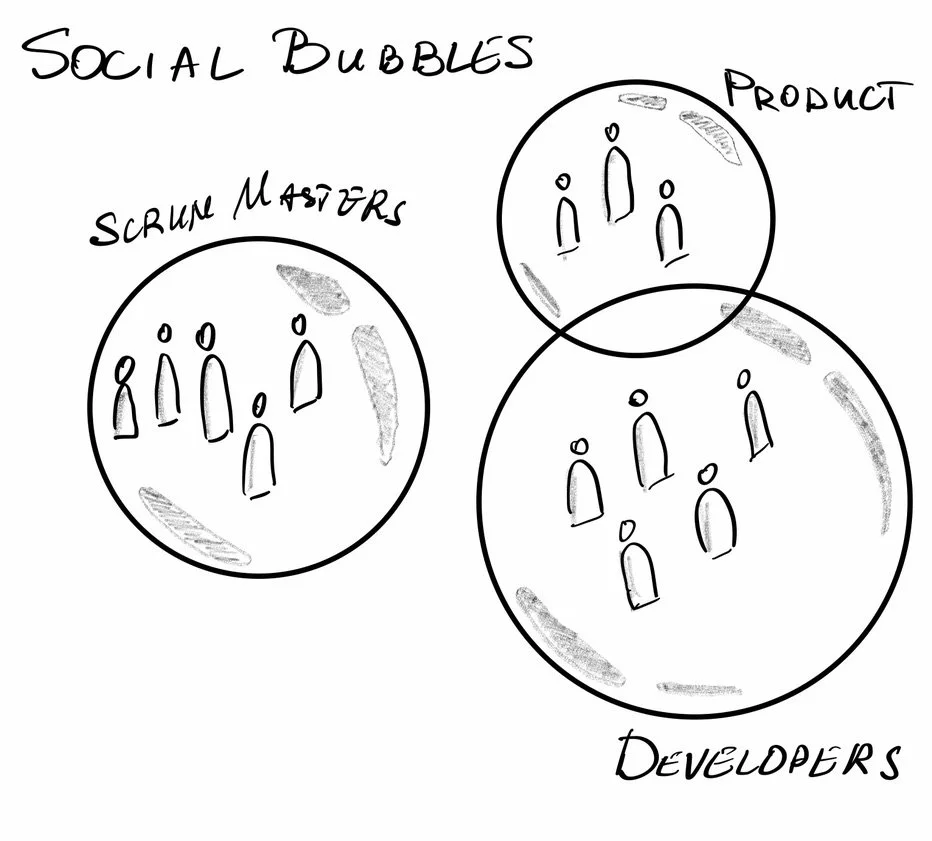
Let's look at an example. As an agile coach/scrum master, it is very easy and soothing to stay in the agile bubble - after all it is our professional duty to stay up to date within our own field. We gladly dive into the newest colorful retrospective templates, liberating structures best practices, ice breaker games, flow simulations, planning tools, framework-bashing, 'agile is dead' debates, you name it! It is fun, we know each other, we feel validated and cozy, we feel important, competent, strong. With so much strength and positivity, the reality must be wonderful, no?
And yet over time, we've seen our perceived value diminish and the role losing its importance. Could this comfy social bubble we are in - both online and at the workplace - have something to do with our own demise?
The Comfort of the Echo Chamber
Isn't it a form of cognitive dissonance to write on CVs how we break organisational silos, and yet when it comes to our own learning and interests, we comfortably stay in one ourselves? Isn't our own value derived from our ability to help and guide others? How much do we actually know about what is on those other people's minds?
The other Bubbles Learn too
In my experience, when I talk with other agile coaches or scrum masters, I rarely find them to be familiar with the trending topics in software development that are closest to our work. Think Domain Driven Design, Team Topologies, DORA Metrics, The c4 model, the DevOps movement, arc42 documentation, sociotechnical engineering — topics that are daily conversation for engineers, and almost absent from agile coach circles.
Those are all very important and not too technical topics on the minds of engineers. And instead of listening closely what really is boiling hot amongst engineers, we prefer to passionately and comfortable engage in endless framework battles, or for the 1000th time talk about story points. The world has meanwhile moved on to a different road. And our choice to stay in the comfort zone made us miss the train.
It’s more than just drift - it fuels conflict
It’s not just about natural drift here - but rather the consequences of this drift. At work we need to connect with people of so many backgrounds and skills to get stuff done. The more we retreat into our own bubble, the less capable would we be to genuinely connect to people from outside our bubble. Our bubble is just so very well aligned and learns, moves at its own pace. If we fail to step out of our bubbles and don't mingle with the other bubbles, we risk becoming detached from the reality of others, forming our own, possibly greatly different one. And that breeds conflict. The conflict between tech and scrum masters, business and scrum masters and possibly many more. Not the healthy conflict - but the one born of misaligned values, superficial understanding of each other’s context and the lack of shared “me too” moments. This should be a metric: How many “me too” moments do you have with your co-workers about work? Have you tried that? Let’s run and experiment to see if teams where everyone shares a similar amount of “me too moments” with each other might be higher performing than such that don’t.
Too simple?
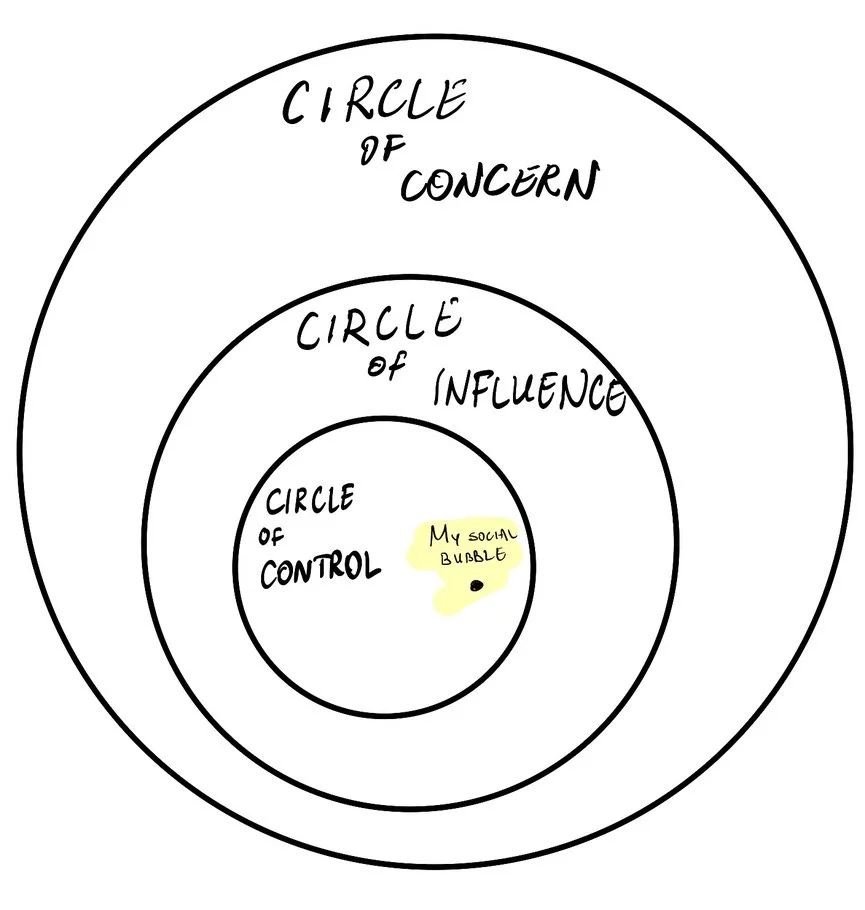
I am not trying to say this is the only reason agilists are struggling right now. There's definitely much to be said about how difficult it can be to affect change in a company that is not yet ready for it. Many businesses will survive years and decades before a disruptor overtakes them. And then it is too late to do anything. The current economy with its focus on short-term gains over long-term prosperity is certainly not helping. The problems we face are nuanced and numerous. Still, being in a social bubble is a problem in our circle of control! If we are in one, we can choose not to be. We can choose to become knowledgeable and wise about what the other bubbles struggle with and draw from our own experience to help them. Sure, it requires action, taking the harder, rockier path. We might stumble, fall, feel embarrassed, a beginner again, and that is on us to deal with and overcome.
What Are We Actually Missing?
The more experienced in our field we are, the more daunting it might feel to ask a question that could expose us as not so knowledgeable after all. We might have to deal with our own insecurities and imposter syndrome, which can be truly hard. But really, what's the worst that can happen? We've been there before, we've been beginners before and we've made it where we are. And actually, today it might be easier than ever to get out of our own bubbles.
Get out of the Bubble
Let me give you an example: I helped co-organise a meet-up about collaborative modelling - mostly engineers, engineering managers and product people join, under 1% are agile coaches/scrum masters. We often practice Event Storming that was created by Alberto Brandolini. The most frequent question we get is - how to bring this into our organisation? The second most common one - how do I facilitate it properly? And yet, I am one of two agile coaches I know who know how to do it. Why? Event Storming has been around for 13 years. It is an established workshop format. It should be in our standard toolkit. Sure, there is a lot of buzz out there and lots of things to try out. But this is something even developers want to do - a meeting they want - a rarity in its own right! Why aren't we all over this? Event Storming can be very easy to understand, no matter your background, and there is an abundance of material about the format - you only have to choose to explore it.
Another example is CI/CD and all the debates around code reviews, blocking vs non-blocking pull requests, trunk-based development vs git flow, or why continuous integration of small chunks leads to higher quality, etc. I have not met many scrum masters or agile coaches that are knowledgeable enough on this topic, even though you can’t have agile without all that - if your test automation and ability to continuously integrate and deploy is very poor, you can try be agile and it just won’t work.
I have other examples. I believe you get the point. Johnathan Smart's incredible book "Sooner, Safer Happier" proposes to "pop the bubbles". I think in some cases we need the bubbles to exist. But just like cells that form complex organisms by beneficial interactions, we must also learn to cross the bubbles' boundaries into other bubbles and exchange and support each other. It doesn't have to be hard: I sometimes go to HR meetups only to learn that they are actively experimenting with kanban boards and sprints! It doesn’t take me much effort to go there, I just have to get my head around the idea that the people I meet there won’t have the same background as I do and I would have to explain my role a few times.
A Challenge
So — what's the next bubble you'll step into? Pick one thing. Not because it's comfortable, but because it isn't. The view will be worth every stumble!